Showing posts with label revenue. Show all posts

Wednesday, April 3, 2013

Good news: personal income jumps in state. Not-as-good news: Help for state budget diminishing

The total personal income for everybody in the state of Washington added together rose by 4.5% from 2011 to 2012, the fourth-highest percentage increase among the states, the federal government says.

So a lot of folks saw their income go up last year, which is certainly good news.

And you might think that would also be good news for the hard-pressed state budget, since a bit of those increased earnings might be spent on stuff that's covered by the state sales tax.

Turns out it's not such a budgetary boon. Why? Because over the last 20-odd years, state government has tapped an ever-declining share of that personal income to pay for education, the State Patrol, bridges and highways, foster care and all the other services the state provides.

Part of the reason for that is that the Legislature is very reluctant to raise taxes.

Another part of the reason is our revenue system – which, according to the Institute on Taxation and Economic Policy, is the most regressive of any state's ("most regressive" means that in Washington, the rich pay less and the poor pay more than anywhere else, in terms of their shares of the total tax burden).


All of that makes balancing the state budget a tough job. That's the main task before the state House and Senate right now, and we will see their ideas for how to do it announced soon.

Monday, March 25, 2013

Main Street businesses: Close tax loopholes, invest in future

It’s not every day that a business group calls on legislators to resist budget cuts, raise revenue and invest wisely to boost the economy and fuel consumer demand, but Monday was one of those days.

“We need customers – not cuts!” a coalition of small-business owners from across the state said in a letter hand-delivered to Rep. Reuven Carlyle of Seattle in the Legislative Building. “We believe it’s time to refocus our political debate on generating revenue to create the investments we need to support small businesses,” the letter said.

The letter called for closing tax loopholes for big corporations or adopting new revenue measures in order to raise money for health care, education and infrastructure. It was signed by more than 170 members of the Main Street Alliance.

“We believe that an economy works best when everyone pays their fair share,” the letter said. “When essential public services are cut, our economy suffers, people lose their jobs and small businesses lose our customer base.”

The letter was delivered by Consuelo Gomez of Marty K Comprehensive Facilities Maintenance in Bellevue, Tiffany Turner of Adrift Hotel and Inn at Discovery Coast in Long Beach and Don Orange of Hoesly Eco Automotive in Vancouver.

Carlyle has long advocated for increased accountability for tax loopholes granted to businesses and industry sectors. As chair of the House Finance Committee, he is working this session to make sure that the exemptions are linked to measurable economic benefits.

Read this story in Spanish.

Wednesday, January 30, 2013

People are talking: Good turnout so far for Pollet's 'Traveling Town Halls'

Rep. Gerry Pollet
State Rep. Gerry Pollet's Traveling Town Halls are proving to be a pretty decent ticket for folks who have something to get off their chest on Saturday mornings.
The46thLegislative District meetings stem from Pollet’s past experience organizing carpools of parents and others into a three-to-four-hour weekday excursion to Olympia -- for just a few minutes of face time with legislators. These Traveling Town Halls allow constituents to meet with Pollet most every Saturday morning from 10 to noon at various locations around the district, instead of trekking to Olympia.
Pollet has already welcomed three-dozen citizens to his first two meetings earlier this month: the premier 2013 get-together at the U-Village Burgermaster and his most recent constituent-conversation at the Lake Forest Park Town Center. Pollet's informal meetings -- you might even call them "Flash Town Halls" -- start at 10 most every Saturday morning. The next one is this Saturday, Feb. 2, at Diva Espresso, which is located at 8014 Lake City Way Northeast (between north 14th Avenue and north 15th Avenue). Pollet and Kenmore Mayor David Baker will hold a joint Traveling Town Hall on Saturday morning, Feb. 9, at Espresso Works, which is located at 6734 Northeast 181st Street in Kenmore.
"We’ve covered local issues, for sure," he said of the meetings so far, "such as the red-light-camera authority at the 'Five Corner' intersection of Sand Point Way Northeast and Northeast 45th Street. And we’ve engaged in spirited discussions on statewide issues, such as potential reforms in the revenue system, funding for education, and reducing gun-violence."
Pollet launched his traveling-office tradition last year, holding Saturday-morning meetings all over the 46th District during the 2012 legislative session. With the 2013 session now in full swing, he said he wants residents from 46th District neighborhoods to have an opportunity to speak their minds without having to travel to Olympia.
Folks can always find information on Pollet's in-district meetings -- as well as information about a wide variety of community, legislative, and state-government issues -- at his legislative website.

Thursday, January 24, 2013

When it comes to taxes, we’re one of the best and one of the worst

On the one hand, the Tax Foundation consistently says that Washington has one of the top ten best business tax climates. We rank sixth in their 2013 index. But the Institute on Taxation and Economic Policy's most recent "Who Pays?" report says Washington is the state with the most regressive tax system.
So who's right?
They both are. One of the reasons the Tax Foundation has Washington in a privileged spot is because we don't have a state income tax.
And what makes our state's tax system uber-regressive is best explained in a brand new study prepared by the Office of Financial Management, where we found that:
The state's poorest 20 percent pay 9 percent of their personal incomes in state and local taxes, while the richest 20 percent pay just 2 percent. You read correctly, the reality in our state is that the poor pay 4.5 times as much, percentage-wise.
This Crosscut story has more information on how poor folks are stuck with a larger chunk of the bill.
The OFM study was presented to the House Finance Committee on Monday. Click this TVW link to watch it online.

Read this story in Spanish here.
 

Thursday, January 17, 2013

Liquor Control Board holding public forums on new marijuana law implementation

The Washington State Liquor Control Board (LCB), which is responsible for implementing Initiative 502 and regulating recreational use of marijuana, has announced that they will hold six public comment periods around the state.
Voters approved I-502 with 56 percent of the vote in November's election. While it laid out some specific provisions – including legalizing possession of up to one ounce of marijuana as well as details of a state licensing scheme – many details were left up to the LCB to decide.
Now, they are seeking to hear from citizens on how to best fill in the gaps.
“This is an opportunity for the public to meet the Board and staff involved in implementation, learn about our role in implementation, and to provide testimony,” LCB Chair Sharon Foster said in a statement.
The first public hearing will be in Olympia on the evening of Tuesday, January 22. Here is the full list of statewide public hearings:
  • Tuesday, January 22
WSLCB Headquarters, Conference Room 201
3000 Pacific Ave SE, Olympia, WA 98501

  • Thursday, January 24
Seattle City Hall, Bertha Knight Landes Room
600 Fourth Ave, Seattle, WA 98104

  • Thursday, February 7
Clark College, Vancouver, Foster Auditorium
1933 Fort Vancouver Way, Vancouver, WA 98663

  • Tuesday, February 12
Spokane City Hall, Council Chambers
808 W Spokane Falls Blvd, Spokane, WA 99201

  • Tuesday, February 19
Skagit Valley College, Mt. Vernon, Theater
2405 East College Way, Mount Vernon, WA 98273

  • Thursday, February 21
Yakima City Hall, Council Chambers
129 North Second St, Yakima, WA 98901


Read this story in Spanish here.

Thursday, January 10, 2013

Specialty plates bringing in the bucks

Bill signing for House Bill 1329, 5/3/2011
Back in 2011, Representative Marcie Maxwell partnered with Music Aid Northwest to support Washington students. Maxwell introduced House Bill 1329 to create and sell “Music Matters” specialty license plates to benefit music education programs in our schools. Upon introduction of the bill, Maxwell noted that “We must acknowledge the essential value of music education and continue to promote a well-rounded curriculum for all Washington students”.
Earlier this week, the Everett Herald reported that specialty license plates like “Music Matters” are creating somewhat of a windfall for nonprofit organizations and state agencies. In fact, about $1.9 million was collected from July 2010 to December 2011 according to a report from the Department of Licensing. These dollars go to support a variety of causes aside from music education, including wildlife protection, trail maintenance, and support for law enforcement officers, soldiers, and professional firefighters.
The Herald also reports on the importance of these specialty plates for students at our state's public universities.
But the report only tells part of the story because it does not include plates issued before the law took effect. Among those are the most popular specialty plates on the road -- those for the state's six public four-year universities. Those plates have been generating money for scholarship funds since the mid-'90s.

For some it's a big deal.

Take Washington State University. There were 3,454 WSU plates sold and 18,199 renewed between July 1, 2011 and June 30, 2012, according to Department of Licensing records. That alone brought in more than $500,000 for scholarships.
These figures are just another example of how the state can partner with non-profits entities with successful results. Plus, Washington drivers get to support their favorite causes without cluttering their bumpers- not that we have anything against an impressive display of bumper stickers. You can read the entire piece on specialty license plates over at the Everett Herald’s website. The report prepared by the Department of Licensing will be delivered to lawmakers next week, just in time for the 2013 legislative session.

Tuesday, November 27, 2012

Online sales tax windfall for state?

Just about a year ago, the state Department of Revenue pointed hopefully to the introduction in Congress of a bill that would require online retailers to collect sales taxes and funnel the revenue to their customers’ home states. The measure could generate hundreds of millions of dollars a year for state and local governments in Washington, the department said. Legislators, including Rep. Ross Hunter of Medina, praised the bill.
The idea is still alive – and now Gov. Gregoire is calling on Congress to approve the proposal as part of the negotiations to avoid the so-called fiscal cliff.
 
If enacted, the federal Marketplace Fairness Act could provide the state with an extra $560 million in sales-tax revenue in the 2013-15 biennium, the revenue department estimates. Local governments would take in an extra $175 million in the same period. Those amounts would increase significantly in subsequent biennia as compliance improves and online sales grow.
 
Washington could start collecting taxes within 90 days after a congressional OK because Washington is one of 24 states to adopt the Streamlined Sales and Use Tax Agreement. The Legislature authorized that in 2007.
 
The federal act would set aside a 1992 U.S. Supreme Court decision that excused online retailers from collecting sales taxes from customers who live in states where the retailer lacks a physical presence. Supporters of the bill say it would level the playing field for traditional brick-and-mortar retailers who must collect state and local taxes on sales in their stores.
 
But although the bill enjoys bipartisan support, at least one congressman from Washington state is skeptical of its chances in this year’s lame-duck session.

To read this story in Spanish, please click here.
 

Wednesday, May 2, 2012

Revenue problems – and solutions

In a four-part online series last month, the private, nonprofit Washington State Budget and Policy Center examined the long-term fiscal challenges facing the state – and included a nifty graphic on the current dysfunctional revenue system. 

That graphic highlighted shortcomings in the current system, including its extremely regressive nature, its failure to reflect growth in the state’s economy and the proliferation of open-ended tax exemptions.

Some members of the House Democratic Caucus were ahead of the curve on this. Back in February, several legislators – mostly first-termers – rolled out a reform package that addressed these concerns and more. The Legislature did not approve those measures before adjourning – but the problems remain.

To read this story in Spanish, please click here.

Wednesday, February 29, 2012

The budget has passed the House!

A budget that is balanced, supports basic education, maintains the social safety net, AND keeps higher education affordable – at the same time as per-capita revenues are at a 50-year-low? That is exactly what Rep. Ross Hunter and the House Democrats have put forth in their 2012 supplemental budget (HB 2127).
While it was necessary for some cuts to be made, the 2012 supplemental budget that just passed the House tonight continues to fund vital programs like Disability Lifeline medical services and the Basic Health Plan. Elimination of the Basic Health Plan would mean 35,000 residents would be completely uninsured, not to mention removing all hope for the 150,000 Washington residents on the waiting list. By keeping these important programs running, we are enabling Washington to bridge the gap to 2014, when the Affordable Care Act is expanded, providing insurance coverage for hundreds of thousands of Washington residents.
This budget will also enable Washington to better meet its “paramount duty” to fund basic K-12 education, as reinforced by the state Supreme Court in January.
This budget actually spends less than the most recently projected revenues. After adjusting for inflation, Washington state is currently spending at 1985 levels, with the lowest state and federal tax rates in 50 years. These are hard times financially, but let’s not forget the February official revenue forecast which included the first increase in four years, as well as a predicted decline in welfare cases. In layman’s terms, this means $400 million on the upside. 

To read this story in Spanish, click here.

Thursday, February 16, 2012

State budget gets second shot of good news this month


The state revenue collections are looking up for the first time since the spring of 2010, giving state budget writers a second bit of good news for the month.

The Economic and Revenue Forecast Council met this morning and adopted a revised forecast for the current biennium and the first forecast for the 2013-15 biennium.

In the current biennium, revenues are expected to grow by about $45 million.  The forecast shows an increase of about $96 million, but $51 million was part of the budget proposal adopted in December 2011.  That funding was due to HB 2169 which dealt with earlier collection of unclaimed property. 

Last Wednesday it was announced that a reduction in the demand for state services has saved the state around $340 million.  All this good news has reduced the current budget shortfall from about $1.5 billion to more like $1.1 billion.

"It's the first positive forecast we've had in nearly two years," said House Ways and Means chair Ross Hunter, "so of course I'm happy to see it.  However, much of the uptick is due to policy changes we made in December.  We're still fighting the effects of the recession and need to temper our optimism with caution."

Friday, February 10, 2012

Rep. Carlyle discusses tax exemption reform

Rep. Reuven Carlyle, a democrat from Seattle, introduced legislation that would fundamentally change the way the state approaches tax exemptions.  Rep. Carlyle introduced a bi-partisan plan at a press conference with Rep. Glenn Anderson, a republican from Fall City, last Friday.

House Bill 2762 would add expiration dates (also known as “sunsets”) to 251 tax preferences currently in state law. These tax breaks, some of which have been on the books since 1935, are worth about $2 billion in tax revenue that won’t be collected in 2013.

“Today, tax exemptions, credits, and loopholes in our state in effect can’t be terminated, they can’t be modified, and they can’t be changed,” said Rep. Carlyle. “That’s bad public policy regardless of how your politics come down.”

Carlyle is referring to the voter-approved Initiative 1053 that requires all tax increases to receive a two-thirds super-majority vote of the Legislature to become law.

Under HB 2762, these types of tax preferences would expire every ten years unless the Legislature votes, by a simple majority, to reauthorize them.

Rep. Carlyle emphasized that this is not intended to be a short-term budget fix. He hopes this bill will help get a conversation started with other lawmakers about problem of “philosophical inconsistencies” in the legislative process of enacting and repealing tax breaks.  “This is about instituting long-term, structural, responsible reform.”

You can read about more about Rep. Carlyle’s proposal here, here, and here.

To read this story in Spanish, click here.

Wednesday, February 8, 2012

House Transportation leaders advance focused revenue package!


Exciting news!
Yesterday, House transportation leaders addressed urgent state and local needs while creating, or sustaining, thousands of jobs all over Washington by advancing a great revenue package!
“Low interest rates and very low bids from businesses competing for construction contracts make this an ideal time to take care of some of our most pressing needs in transportation,” said Rep. Judy Clibborn (D-Mercer Island), who chairs the House Transportation Committee.
The centerpiece of this package, which passed out of committee yesterday, is HB 2660 which is expected to generate about $1.35 billion over the next ten years by adding a $1.50 fee on barrels of refined oil in our state. Revenue from the oil-barrel fee would be split 50-50 between the state and local governments. This new plan exempts oil that is exported to other states or used for non-highway purposes, such as aviation and marine fuels.
“Just by itself, the oil fee we’re proposing would support around 1,100 jobs annually,” said Marko Liias (D-Edmonds), a vice chair of the committee.  “These are good-paying, private-sector jobs for construction workers, who’ve been hit harder than anyone else by the economic downturn.”
In addition to the revenue measures, the committee passed a proposal (HB 2704) by Rep. Andy Billig (D-Spokane) to create a task force for exploring new approaches to funding transportation as the state becomes less reliant on fossil fuel.
“Today we passed a focused revenue package for urgent needs,” said Billig, also a vice chair of the committee.  “It doesn’t try to replace the nearly $5 billion of gas-tax revenues that we’re expecting to lose over the next dozen or so years due to increased fuel efficiency and other factors. But it will put people to work right away on state and local needs that just can’t wait.”

Wednesday, November 23, 2011

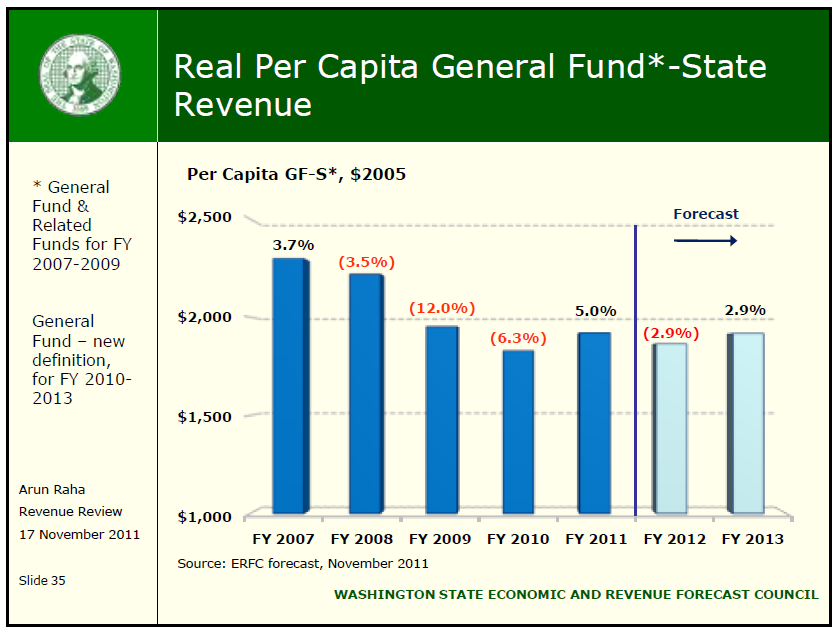
Is Washington's revenue REALLY down?

It is often suggested in some quarters that Washington doesn't really have a revenue problem at all, despite the fact we have had to take budget reductions of more than $10.5 billion over the last three years.  During his presentation at the Washington State Economic and Revenue Forecast Council meeting last week, chief economist Arun Raha pretty well dispelled that myth. 

As you can see from the charts below, state revenues are currently way below the 2008 level, and will continue to be lower at least through 2013.  Revenues have also not kept up with population growth, according to Raha.


There is more information available here.

Thursday, November 17, 2011

State’s budget situation continues to deteriorate – but at a slower pace


The Washington State Economic and Revenue Forecast Council released its quarterly revenue forecast Thursday morning, and it indicated that, although there are some bright spots on the horizon, our economy is still not back on track. 

The council’s executive director, Dr. Arun Raha, reported that the revenue forecast for the 2011-2013 biennium is now $122 million lower that it was just two months ago, bringing the current budget shortfall to about $2.1 billion. That’s the difference between the spending outlined in the biennial budget adopted by the Legislature earlier this year and the now-anticipated revenue for the period, allowing for an ending balance of about $400 million as a reserve.

During his report, Dr. Raha made the following points:

·         Our economic recovery is threatened by events outside the state of Washington – mainly, the European debt crisis and the political gridlock in Congress.

·         Washington’s employment numbers are not great – but Boeing is doing well, as is the software industry. 

·         State and local governments are shedding jobs, including  900 from the state’s liquor system due to the imminent privatization of hard-liquor sales under the ballot initiative approved by voters this month.

·         Consumer confidence is still weak.

The Legislature will begin a special session Nov. 28 to address this budget situation.  Our budget writers have been working for several weeks now developing options, finding more efficiencies and cuts, and looking for additional reforms.

To read this blog post in Spanish, please click here.

Thursday, September 15, 2011

State revenues continue to decline

Citing the "fragile aftermath of the Great Recession." the Executive Director of the the state Economic and Revenue Forecast Council delivered some bad news today: the revenue forecast is now $1.8 billion less than it was when the 2011-13 was written just months ago.  And, Dr. Arun Raha continued, it doesn't look like things will turn around any time soon.

Dr. Raha made these points during his presentation:
• Every time our state has looked like it would break out of the malaise, it has been sucked right back in.

• The gridlock in Washington DC and the instability of the European markets are affecting our recovery.

• It appears that we are at best in for an extended period of muddle-through – slow economic and job growth, high unemployment, and weak confidence. The risk of a double-dip recession too has increased.

• Consumer confidence is headed back down, as are sales expectations and small business optimism.

Representative Ross Hunter, chair of the House Ways and Means Committee and a member of ERFC, noted that budget leaders are already combing through the budget again. "This is a serious problem and it demands a serious response," he said. " We're working on that response now, and we have months of work still ahead of us. I am ready to work with all members to solve this problem."

The full ERFC report can be found here.


To read this blog post in Spanish, please go here.

Wednesday, August 24, 2011

The Op-Ed by Rep. Chris Reykdal The Olympian Won’t Print

In his latest column-turned-open-letter, Rep. Chris Reykdal challenges the local McClatchy papers, which have been devoting large amounts of ink and bytes to legislators who have - and haven't - voluntarily reduced their salary by 3 percent, to perhaps focus on real budget solutions, and possibly ask more of themselves in return.

Here's an excerpt:
A salary cut is symbolically important to be sure, but not a viable answer to our budget woes. The state tax exemption your corporation and other newspapers in Washington enjoy is worth $32 million biennially. That is 170 times more than the money saved by a 3 percent cut in all legislators’ salaries (estimated at $190,000 or 0.00122 percent of the Near General Fund budget).

Taken a step further, if we could recoup just 3 percent of all the tax preferences under the direct control of the Legislature (not those subject to federal commerce restrictions and other constitutional limitations), we would add $360 million biennially to the State budget. Our kids, our college students, our elderly, our most vulnerable, our environment, and most of our small businesses would all be a little better off with that sacrifice.
Read the full column here

To read this blog post in Spanish, please go here.


Monday, July 25, 2011

Rep. Chris Reykdal on the court challenge to I-1053

When I was sworn in as the new state representative from the 22nd Legislative District, I took an oath solemnly swearing to support the Constitution and laws of the state of Washington. That Constitution also guarantees a people’s initiative process, which is held sacred in our state. I will always defend that right in accordance with the Constitution.

There is a real question, however, whether Initiative 1053 is in accordance with the Constitution. There is concern that I-1053 did not attempt to amend state law; it attempted to amend the state Constitution, something I take very seriously.

Article II, Section 22 of the state Constitution clearly vests the powers of lawmaking in the Legislature with a simple majority. I-1053 requires a two-thirds vote of the Legislature to not only raise taxes, but also to close outdated and unproven tax preferences/loopholes. We all know our tax code desperately needs modernization, but I-1053 makes it nearly impossible to bring about changes. Under I-1053, just seventeen out of 147, or 11 percent of our legislators, control our tax code. This makes it all that much easier for the powerful lobbyists of those that benefit from the most egregious tax exemptions and preferences to target their influence, no matter what the voters of Washington tell us.

This last session many of us attempted to close an inappropriate tax break on large Wall Street banks to fund education for our youngest learners. That effort received a Constitutional majority of legislators who were elected by the people to represent them. Sadly, a minority of House members were able to block its passage.

Now, a coalition of educators and organizations, and some House Democrats who supported the bill are challenging I-1053 and we are looking to the courts for guidance on the matter.

Whatever the outcome, we must get past the simplicity of partisan politics in our state if we are going to make meaningful gains in education, public safety, human services, and other core functions of government. At times this will require cutting some programs as we did this year, and sometimes it will require raising taxes when appropriate.

We can have meaningful tax reform, a balanced budget, and a more effective state government if we legislators are allowed to perform our Constitutional duty. But we cannot make progress without the courts ruling on this matter once and for all. Our Constitution is a sacred document and the rights granted in it should not be altered without a clear constitutional amendment. Not the right to bear arms, the right of free speech, nor the right of taxation by a majority of elected legislators.

I look forward to the Court’s consideration of this legal challenge to I-1053. More importantly, I look forward to working with House and Senate members, the Governor, citizens, and key stakeholders in building a more rational and responsible approach to State Government taxation.

Chris Reykdal
22nd Legislative District

Thursday, June 16, 2011

Revenue forecast shows state still struggling from global recession

The Economic and Revenue Forecast Council adopted a new General Fund-State revenue forecast this morning, showing our state's near-term economic outlook has weakened since the March forecast, but growth expected to pick up momentum later this year, as supply chain disruptions from Japan recede, and oil prices stabilize.

Revenue collections through June 10 were $93 million (2.5%) above what we had expected in the period since the March forecast. This surplus, however, was due to the success of the tax penalty amnesty program, which brought in $198 million more than forecasted, as well as a one-time assessment payment of $40 million. Without the extra amnesty money and other one-time large payments and refunds, collections would have been $142 million (3.8%) below the March forecast.

In summary, the new General Fund-State forecasts are:
2009-11 biennium: $28.2 billion, which is $171 million higher than our previous forecast.

2011-13 biennium: $31.7 billion, which is $183 million lower than our previous forecast.

Here are some of the main points from Dr. Arun Raha's executive summary:

  • The U.S. economy has entered another soft-patch in a recovery that is proving to be far more bumpy and fragile than usual.
  • The largest part of the increase in consumer spending in April was money spent on gas and other energy goods.
  • The repercussions from the disaster in Japan have turned out to be worse than we had thought.
  • The May employment report for the nation was disappointing and confirms the slowdown in the economy.
  • However, the economy is on the cusp of faster job growth if there is any increase in aggregate demand.
  • With state and local governments cutting spending across the nation and the federal government on hold, the level of government demand is shrinking. So the recovery must now necessarily depend on private demand from domestic and overseas consumers and eventually businesses.
  • The private sector added 11,100 jobs in March, April, and May but public sector employment declined by 2,700 jobs yielding a statewide gain of 8,400 jobs.

Here's the link to the forecast materials.

UPDATE: Some clarification to the numbers above...

The revenue forecast after a legislative session is often difficult to explain, because since the March revenue forecast, the Legislature adopted a number of changes that impact the revenue situation. This means the June forecast accounted for a number of changes which the Legislature had already assumed and a number of changes which were new.

For the current (2009-11) biennium, revenues were down, but amnesty receipts made it look positive since March. Compared to the balance sheet you'll see in the adopted budget, it was down by $184.7 million. That means that we are now negative $84 million in the State General Fund.

For the 2011-13 biennium, when compared to the legislative balance sheet (which can be found on page 8 here), revenues are down $387 million. Dr. Raha's comments made it sound better by saying it was only down by $183 million. The difference was not counted by the Legislature previously and was the impact of the amnesty program. He assumed that quite a bit of revenue that came in during the current biennium would have otherwise been part of the 2011-13 biennium.

Bottom line: The State General Fund is now negative $118 million. However, with over $281 million in the Budget Stabilization Account (rainy day) the total reserves are still positive – at $163.3 million.

When you add both biennia losses together, total revenues have dropped $571.8 million.

Tuesday, June 14, 2011

One nation, in the red...

An AP report today shows that nearly every state in the U.S. is still suffering from a shortfall in tax revenue due to the Great Recession, exacerbated now by the end of federal stimulus money.

The story goes on to cite the following:

• Twelve states started the year with deficits that were equal to 15 percent or more of their general fund, the budget that covers day-to-day operations.

• States with the highest per capita number of Medicaid recipients were among those with the largest budget deficits, as a percentage of general fund revenue.

• Twenty states enjoy general fund budgets that exceed their 2007 levels, while the remaining 30 states are still running behind.

• Tax revenue in Arizona, hit hard by the housing collapse, remains 19 percent below 2007 levels, the largest difference among the states. Next are California and Florida at 18 percent, and Michigan and Tennessee at 17 percent.

• The 50 states have a combined $689.5 billion in unfunded pension liabilities and $418 billion in retiree health care obligations. Five states have unfunded public employee pension liabilities of $50 billion or more.


Of those who have tried to cut or tax their way out of the hole:

In some cases, states have taken steps that actually made their fiscal situation worse.

In Louisiana, for example, the drop in the state's general fund can be tied in part to hefty income tax breaks passed by lawmakers in 2007 and 2008 for middle- and upper-income earners. The permanent tax cuts drained an estimated $580 million the state would otherwise have received this year and similar amounts in future years.

Most states have resisted the temptation to raise taxes during the recession, but there are exceptions.

Then-Gov. Arnold Schwarzenegger agreed to temporary increases in California's personal income, sales and vehicle taxes in 2009. Gov. Jerry Brown, elected last fall, wants to renew those increases for up to five years to bring in more than $9 billion annually.

Since the recession began, New York's general fund has shot up $3.5 billion, or 7 percent, largely because of some of the biggest tax and spending increases in state history, including a $4 billion income tax hike on wealthier residents.

In Illinois, state revenue is 20 percent higher than in 2007 after income taxes were raised. The $6.8 billion that the increase is expected to generate will allow Illinois to avoid some cuts and spend money on neglected programs, particularly the state's underfunded pension funds.

Read the full story here.

To read this blog post in Spanish, go here.

Wednesday, May 11, 2011

Mixed news in latest revenue update

This month's Economic & Revenue Update is out. According to our chief economist, the country's recovery has hit a "road bump" thanks largely to rising gas prices and slow GDP growth.

For Washington state, the news is (very) slightly better. Our state economy is still growing, but a bit more slowly than the past couple months. Revenue for April came in $157.7 million higher than projected in March, but that was due to larger-than-expected tax amnesty receipts. Without that boost, we would have actually collected $26.6 million less than projected.

You can read more here.

Apture