Showing posts with label State rankings. Show all posts

Monday, February 11, 2013

The state of gun laws

​Washingtonians have been flocking to local law enforcement offices to acquire permits to carry concealed weapons, according to a recent news report. Gun sales, too, are booming in the state. The surge in demand in both cases likely arises from fear of impending restrictions on gun ownership in the aftermath of the school shootings in Newtown, Conn.
Gun laws vary widely from state to state. In Washington, the state constitution – in Article I, Section 24 -- includes a stronger and less ambiguous declaration of the right to bear arms than the Second Amendment to the U.S. Constitution provides.
States have different rules about concealed-weapons permits, background checks and many other elements of firearms regulation. Washington, for example, is one of many states that requires no permit for the open (unconcealed) carrying of a handgun, while three states – Florida, Illinois and Texas – and the District of Columbia prohibit “open carry.”
Two national organizations that advocate tighter regulations – the Brady Campaign to Prevent Gun Violence and the Law Center to Prevent Gun Violence – issue scorecards that grade the states on their level of firearms regulation, with more regulation generating a higher grade. In the latest Brady scorecard, Washington scored 15 out of 100, which actually placed well within the top half of scores nationwide (California was first, with 81). On the Law Center scorecard, Washington rates a “C” -- again, well within the top half of the class.
In 2008, the Law Center reports, Washington had the 15th lowest number of gun deaths per capita. Generally, the center says, there is a strong correlation between high grades on their scorecard and low gun-death rates.

Read this story in Spanish.

Wednesday, February 6, 2013

We're No. 6!

​And that’s not bad at all: Forbes magazine ranks us –actually, the Seattle-Tacoma-Bellevue metropolis – as the sixth fastest-growing city in the United States.
The magazine took a nationwide look at the 100 largest “metropolitan statistical areas” -- a federal definition that groups cities with their suburbs and other nearby urban centers – and ranked them by growth in population, employment and economic production, with some other measurements factored in.
 
Three Texas cities – Austin, Houston and Dallas –topped the list, and a fourth, San Antonio, ranked ninth. Behind Seattle, another Pacific Northwest city, Portland, rounded out the top 10, while Boise, Idaho, came in at No. 15.

Read this story in Spanish.

Thursday, November 29, 2012

Washington in top third of best-managed states

One of the best tax climates for biz - that's us!
Washington has landed a respectable 16th on a list of the "best-run" states.  
The management-efficiency catalogue is compiled by 24/7 Wall St., LLC, a Delaware-based financial news and opinion outfit. After they go out far and wide all over the Internet, the company's articles are rerun by many of the world's toniest websites and portals for financial info and other news. You can find these items, for instance, in AOL's DailyFinance, MarketWatch, MSN Money, Yahoo! Finance, The Huffington Post, and -- well, you get the picture. 24/7 Wall St. says it "publishes over 50 articles per day and has readers throughout North America, Asia, the Middle East, and Africa." 
Each year in their work to determine these state-management standings, the folks at 24/7 Wall St. look at every state's financial health, standard of living, and government services. "The successful management of a state is difficult to measure," emphasizes 24/7 Wall St. "Factors that affect (a state's) finances and population may be the result of decisions made years ago. A state's difficulties can be caused by poor governance or by external factors, such as extreme weather."
Top benchmarks used in this state-of-the-states roundup are:
  • Debt per capita.
  • Budget.
  • Unemployment rate.
  • Median household income.
  • Percentage of population below poverty line.
Also at the 24/7 Wall St. website you can link to the firm's lists of:
A key factor in Washington's falling well out of the top 10 is our "budget shortfall equal to nearly 30 percent of our general fund in fiscal 2011 -- one of the largest (budget shortfalls) in the nation."
What shoots us up toward the top, though, is the TLC we invest in managing our pension liabilities. Pretty near every single dime of the Evergreen State's pension liabilities was funded as of fiscal 2010, a claim only three other states can better. Furthermore, and contrary to some proclamations, Washington actually possesses "one of the best tax climates for business." We are also one of the country's top exporters, with $9,463 in exports per capita last year, which is almost twice the national average of $4,752.

To read this story in Spanish, click here.

Wednesday, June 20, 2012

Good news: Workers making more as economy bounces back

Wages went up in Washington state last year,according to the state Employment Security Department.
The average wage grew 3.6 percent as our state, and the nation, recovered from the global economic collapse.
This good news comes on the heels of a U.S. Chamber of Commerce report putting Washington in the Top 10 states for creating jobs, with that report stating, “Led by the software industry, Washington is one of the few states with a growing information sector. Washington moved up five places into the top 10 largely due to its rapid short-term job growth over the past two years. The state’s manufacturing sector – led by aircraft and other transportation equipment building – significantly outperformed the national manufacturing industry since 2001. The Evergreen State added another 65,000 jobs in professional, scientific and technical services; 19,000 in securities and commodity contracts and 12,000 in electronic wholesale markets.”
The average wage grew from $48,162 in 2010 to $49,894 in 2011, according to Employment Security. The total number of workers covered by unemployment insurance increased by 37,764 last year while total earnings by workers got boosted by $6.6 billion.
From the release by Employment Security:
“Month to month,we’ve been seeing strong growth in industries that tend to offer above-average pay, and that seems to be reflected in last year’s earnings,” said Employment Security Commissioner Paul Trause.
The three industries with the highest wage growth in 2011 were the information sector,with wage growth of 9.5 percent; company management, up 7.9 percent; and manufacturing, up 5 percent.
The 2011 numbers stood in sharp contrast to 2010, when the 2.1 percent rise in the average annual wage was caused mostly by the loss of low-paying jobs. The number of insured workers declined by nearly 32,000 that year, and wages grew by just $1.2 billion.

To read this story in Spanish, click here.

Friday, June 15, 2012

Who says Washington is a top state for producing jobs?

The U.S. Chamber of Commerce, that’s who!

In their latest report, Enterprising States: Policies That Produce, Washington state moved up five places to  #8 on the list of “Top Performing States.”  The group said the rankings were determined by a combination of the following measures:
• Long-term job growth
• Short-term job growth
• Overall expansion of gross state product
• Productivity: state output per job
• Productivity growth: growth in output per job
• Income growth: growth in per capita personal income
• Livability: median income of four-person households adjusted for state cost of living

Quoting the report:
“Led by the software industry, Washington is one of the few states with a growing information sector. Washington moved up five places into the top 10 largely due to its rapid short-term job growth over the past two years.

“The state’s manufacturing sector – led by aircraft and other transportation equipment building – significantly outperformed the national manufacturing industry since 2001. The Evergreen State added another 65,000 jobs in professional, scientific and technical services; 19,000 in securities and commodity contracts and 12,000 in electronic wholesale markets.”

To read this story in Spanish, please click here.

Tuesday, April 24, 2012

We made another top-ten list!

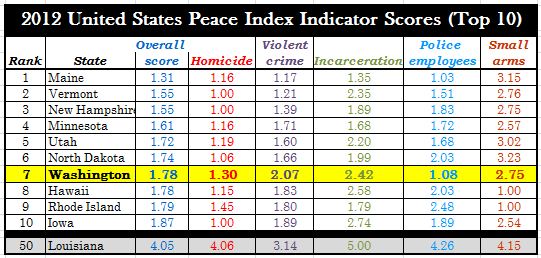
Would you say we’re peaceful in Washington?  According to the just-released 2012 United States Peace Index produced by the Institute for Economics and Peace we are among the top ten most peaceful states in the nation.


The study took into account five indicators to rank each state:
•    Number of homicides per 100,000 people
•    Number of violent crimes per 100,000 people
•    Incarceration rate per 100,000 people
•    Number of police employees per 100,000 people
•    Availability of small arms

And this is how we scored:
 

Michael Killelea, founder and CEO of the institute, said that peaceful states perform better in terms of economy, health and education: “They have higher high school graduation rates, lower poverty, better access to basic services, higher labor force participation rates, higher life expectancy and less single-parented families. Even social capital – like volunteerism, civic engagement, trust, and group membership — is higher in more peaceful states."


Washington has been among the top ten most peaceful states since 2006, but this is the first time we’re at number 7, so we seem to be getting the hang of the peace thing.


For more information be sure to take a look at the report here.

To read this post in Spanish, click here.

Tuesday, April 17, 2012

The Good News, the Bad News, and the Good News

The good news?  According to the U.S. Bureau of Labor Statistics, Washington ranks 8th in the nation in worker pay.  The average salary/wage earned by a working Washingtonian is $50,280.  That’s great; it’s money that supports families, keeps local businesses profitable, and helps to make Washington state, even during an economic slowdown, one of the best places on earth to live.

The bad news is, Washington’s terrific average pay is cold comfort for the 288,000 unemployed people in our state.  True, employment is on the rise, and true, respected economists are saying that Washington is poised to lead the nation’s recovery from this recession.  But you can’t feed a family with statistics.  That requires a job.

Back to the good news:  While the drama in Olympia was playing out around negotiations on an operating budget, Democrats managed to craft and pass bipartisan transportation and capital budgets that will, among other things, create and sustain tens of thousands of good jobs for out-of-work men and women, particularly in Washington’s hard-hit construction industry.

To read this post in Spanish, click here.


Friday, April 6, 2012

They just keep getting bigger…

Recently, Washington has received high marks in terms of county-by-county health, government transparency, AND childcare safety.

Pretty good, right? Just wait because that’s not all - The Tri-Cities metro area tops yet another list, receiving the top spot for the fastest growing metro area in the nation!

Photo credit: Skeezix1000
From the Tri-City Herald this morning:
Population in the Kennewick-Pasco-Richland metro area grew by 4.3 percent between April 1, 2010, and July 1, 2011, the bureau reported.

Franklin county came in not too far behind as the fifth fastest-growing county in the nation. With the biggest numerical boost in population between 2010 and 2011, Moses Lake ranked in the top 10 for micro areas.

To read the full article in the Tri-City Herald, click here.

To read this post in Spanish, click here.

Tuesday, April 3, 2012

“A really incredible culture of health”

The 2012 County Health Rankings report shows that folks who live in the San Juan Islands are relatively healthier than those living in Yakima. But even those living in Yakima are healthier than 90 percent of the nation in certain areas. And in the areas where Yakima ranks considerably below the best counties in the nation, its rankings are nonetheless higher than those in many other states.

In fact, Angela Russell, an associate researcher at the University of Wisconsin said that "Overall, it seems like Washington ... has created a really incredible culture of health."

Could this have something to do with the state’s highly successful Basic Health Plan, which has served as a model for similar programs in other states? Or perhaps with Apple Health for Kids, another state program, to cover all Washington children? Hmmm… food for thought.

But back to the report, the five healthiest counties in Washington are San Juan, Kittitas, Island, Whitman and Whatcom. The five counties in poorest health are Ferry, Wahkiakum, Okanogan, Grays Harbor and Mason.

Even though we’re doing quite well, Mary Selecky, Washington Health Secretary, believes we shouldn’t rest on our laurels. She said we still have to work on quitting smoking, losing weight and maintaining healthy cholesterol levels.

There’s always room for improvement, we know that, but our ear to ear smile from having heard that we have created an incredible culture of health won’t be vanishing anytime soon.

To learn more, read the Associated Press story here.

To read this post in Spanish, click here.


Wednesday, March 28, 2012

Washington gets yet another high mark

We say keep them coming, we can make room on the mantel for another award!

Washington state has earned a perfect score for website transparency for the second year in a row. This means Access Washington is one of the most open and accessible state government sites in the entire nation.

The A+ grade was awarded by the Sunshine Review, a national nonprofit organization focused on government accountability.

Washington is one of just of 10 states to receive such a high mark.

To learn more about the reasons our state website got a perfect score, go here.

Want to check out the acclaimed website? Head on to http://access.wa.gov/ where you can find answers to numerous questions such as where to go for suspected fraud reporting, to how to renew your license, and where to get employment assistance, but you’ll also find names and contact information of elected officials and lobbyists, easy access to contracts and tax information, and information on ethics policies as well as the Washington Public Records Act.

Since its initial launch in 1998, Access Washington has won multiple awards for service, innovation, communication, quality and excellence.

To read this post in Spanish, click here.

Tuesday, March 27, 2012

Washington among nationwide leaders in childcare safety

The National Association of Child Care Resource and Referral Agency (NACCRRA) is a non-profit organization dedicated to ensuring quality and affordable childcare for families across the country. NACCRRA provides statistics, referrals, and other resources to parents in need of a safe place to take their children during the workday. Among those resources, is the “Leaving Children to Chance” report that ranks each of the fifty states, plus the District of Columbia and the Department of Defense, based on their childcare oversight and standards.

According to NACCRRA’s latest report, Washington ranks second in the nation for childcare standards and oversight. Using sixteen different benchmarks, Washington earned 119 points out of a possible 150. Our state is one of seven states that ranked in the top ten for both oversight and program standards, and is one of only nine states that conduct a comprehensive background check for childcare providers. These background checks include fingerprint and sex offender registry checks. Washington saw an improvement in their ranking from NACCRRA’s last report back in 2010.

Other states didn’t fare as well. Only four states, Washington included, earned above a seventy percent or higher on basic requirements for childcare safety. Eight states scored a zero because they allow for six children in a childcare home before requiring a license or don’t require a license for small operations at all. Eight additional states scored a zero because they don’t inspect childcare homes before licensing.
For more information on NACCRRA and the most recent “Leaving Children to Chance” report click here.

To read this post in Spanish, click here.

Wednesday, September 14, 2011

We're Number 1! (Again!)

For the ninth year in a row, Washington state’s 12th-graders led the nation in SAT scores for states where more than half of eligible students took the tests. According to the College Board, the percentage of students tested is important because generally the more kids who take the test, the lower the state score.

Since just about the turn of the century, though, Washington has bucked that trend. The Class of 2011 had a combined average score in reading, writing, and math of 520 – higher than all states in which at least 30% of students took the SAT. New Hampshire just missed the tie with a combined average score of 519.6, and our good friend Oregon scored 513.

The OSPI has more information here.

To read this blog post in Spanish, please go here.

Thursday, September 8, 2011

Honoring our elders – WA No. 2 in nation for long-term care

A national survey ranks Washington as the second-best state in the nation when it comes to caring for seniors.

The report by AARP wasn’t an opinion survey or based on anecdotes. This was hard science and numbers, judged by measuring 25 indicators of quality for long-term care of the elderly.

Here’s a quote from the story published in The Columbian:

“It’s not really a surprise to see that,” said Klaus Micheel, planning and advocacy manager at the Southwest Washington Agency on Aging and Disabilities in Vancouver. “Washington has been known for many years for providing quality long-term care and having a system that allows the frail senior population to receive care in their own homes instead of being locked up in a nursing home.”

For all 50 states, Washington ranked second for supporting family caregivers, third in providing people with choices for long-term care and second in the percent of Medicaid spending that goes for home and community-based care. That’s because we know that letting people remain in their own homes – and be cared for by family members – is the most respectful, compassionate and smartest thing we could do. Institutions are necessary and they do good work. Our first choice, though, is keeping people in their own homes.

There is room for improvement. Tough budget times have meant cuts to all state services. And the report points out some places Washington should beef up, like the turnover rate for caregivers.

On specific indicators, Washington ranked second in the percent of Medicaid spending going toward home and community-based care, third in providing consumers with choices for long-term care and second in support for family caregivers.

Related links:

Columbian story: WA No. 2 in nation for long-term care

AARP of Washington state

Wednesday, April 20, 2011

If you believe the Evergreen State is peaceful, now there’s data to support that claim

Can the level of peace in a state be measured? The Institute for Economics and Peace (IEP) says it can and has issued the first ever United States Peace Index (USPI).

The Index defines peace as “the absence of violence,” and to rank the states, it looked at a set of five indicators per 100,000 people:
• Homicide rates
• Violent crimes
• Percentage of the population in jail
• Number of police officers
• Availability of small arms

According to the USPI, a state’s ranking is strongly correlated with 15 socioeconomic factors, including high school graduation rates, infant mortality, access to basic services, labor force participation rates, and rates of poverty and teenage pregnancy, while median income and political affiliation don’t have an impact on a state’s level of peace.

The USPI ranks Maine as the nation’s most peaceful state, Washington is tenth and Louisiana is the least peaceful state.


“The Index underlines the negative impact of violence on our economy, and reinforces the idea that minimizing violence, through job creation programs and increased access to education and healthcare, dramatically increases the prospects for growth,” said Kerry Kennedy, President of the Robert F. Kennedy Center for Justice and Human Rights. “We should be mindful of this when proposing domestic discretionary spending cuts that will not only disproportionately impact those most vulnerable to violence and poverty, but will also hinder our collective prosperity.”

Kennedy’s comment is timely as many states, including ours, are struggling with insufficient revenues.

To learn more about the USPI and to check out how other states rank, go here.

Thursday, July 15, 2010

Upbeat summer: CNBC ranks Wash. highly for biz climate, ahead of Oregon, Idaho

It’s easy to focus on all the economic chasms that have opened in recent years, but good news does surface from time to time. Business news network CNBC just analyzed all 50 states to determine which ones are best for business, and Washington came in at a healthy 15th place, up one notch from last year. Our neighbors Oregon and Idaho showed up further down at spots 23 and 26, respectively, while Montana and California registered in the 30s.

Unlike other rankings that focus on one metric, the CNBC analysis takes a holistic account of business competitiveness—factors such as technology & innovation, workforce, cost of living, economy and more. Washington ranked particularly high in the areas of access to capital (placing 5th), technology & innovation (5th) and quality of life (8th). We also got high marks for the overall economy (18th) and education (22nd).

Check out the full report here.

Washington’s strong business climate isn’t a new trend, nor is this study an outlier—we’ve covered this long-standing theme several times before.

Wednesday, June 16, 2010

Seattle will be nation’s #2 city over next decade

In terms of “growth and growth potential” in the next 10 years, nobody outside of Austin, Texas will do better than Seattle.

That’s according to Kiplinger’s Personal Finance Magazine, which ranked Seattle second in their July 2010 report on the best cities in the nation. They believe innovation will be key, and in their summary, quote UW’s own Mark Emmert:
After researching and visiting our 2010 Best Cities, it became clear that the innovation factor has three elements. Mark Emmert, president of the University of Washington in Seattle, put his finger on two of them: smart people and great ideas. But we'd argue that it's the third element -- collaboration -- that really supercharges a city's economic engine. When governments, universities and business communities work together, the economic vitality is impressive.
House Democrats are well aware of the importance of innovation to our economy, and have pushed it with Innovation Partnership Zones, and work in the Community and Economic Development and Trade committee which oversees economic strategic planning.

Emmert asserts Seattle has "smart people and great ideas," then the article adds:
Those same attributes drive the Seattle economy, which is preparing for takeoff after hitting a few hard bumps over the past several years, especially in real estate, manufacturing, construction and retail. One shiny new prospect: Boeing's 787 Dreamliner, a commercial airplane that the company says flies farther and uses 20% less fuel than similar-size aircraft.
It's not clear that we're out of the woods with this recession, but it is clear that House Democrats are working to create jobs and that our economy is something to be proud of.

Link to article: Kiplinger's Best Cities 2010: Seattle, Wash.

Friday, November 20, 2009

Healthy brains AND healthy bodies

Last month we learned that Washington ranks third for healthy brains and that the Seattle-Tacoma area ranks as the 7th smartest metropolitan area in the nation. This week we got another high mark as one of the healthiest states.

America`s Health RankingsTM rated Washington as the 11th healthiest state in the country—up from number 13 last year. The report has tracked the health of the nation for the past 20 years, providing a unique, comprehensive perspective on how the nation - and each state - measures up.


A wide range of factors are taken into account to determine a state’s health ranking including infant mortality rates, deaths from heart disease and cancer, smoking and obesity rates, education, pollution and violent crime.


These “health determinants” are good indicators of whether the health status of a state’s residents is likely to improve or grow worse.


Our state scored well because, among other things, only 15.7 percent of Washingtonians smoke – a pretty significant difference from 21.4 percent just ten years ago. Also, the percentage of children in poverty declined from 19.1 percent to 13.2 percent during the past five years, and the infant mortality rate in Washington is 4.9 deaths per 1,000 live births.


But if we want to get a better ranking next year, it’s time to start burning calories and eating healthy foods – in only 20 years the prevalence of obesity among Washingtonians has increased from 9.4 percent to 26.0 percent.


Vermont ranked first this year thanks in part to its low rate of obesity, high number of doctors and a low rate of child poverty, and Mississippi came in last for the ninth consecutive year.


Go to this interactive map to see how other states ranked.

Friday, October 9, 2009

Coincidence? I think not...

What do you know... One moment we're listed as one of the best states for brain health in the country. And the next, devastatingly smart.

According to the Daily Beast's new report, the Seattle-Tacoma area ranks as the 7th smartest metropolitan area in the country, thanks to a ravenous appetite for books while the sun hibernates for the winter.

As we mentioned in our previous post, DHA's Index of Brain Health might attribute our braininess to our fish-rich diets, but to that I say, if our smarts are attributed to fish, then how come fish aren't smarter?

Take that, Science.

Attention Washingtonians: You live in one of the brainiest states in the nation!

Washington state has just been named in another “best places” survey – this time, the best place for brain health.

That’s right, Washington ranks third in the nation for healthy brains, thanks to our appetite for fish, our love of reading, and our high percentage of breastfed babies. These are our brainy strengths, according to the DHA Index of Brain Health. The study evaluated the 50 U.S. States and the District of Columbia, and based its findings on 21 indicators in the areas of diet, physical health, mental health and social well-being. Only DC and Maryland topped Washington.

Docosahexaenoic acid (DHA) is an omega-3 fatty acid that is required in high levels in the brain as an essential nutrient for optimal functioning (learning ability, mental development.) The more fish you eat, the more Omega 3 you will get into your system, and, theoretically, the healthier your brain will be.

The 21 categories of brain health measures include consumption of DHA-fortified foods, supplements and fish, breastfeeding rates, amount of sleep, smoking rates, Alzheimer’s disease prevalence, religious, spiritual and community involvement and education state rankings.

To learn more and to see how other states ranked, go here.

Apture