Friday, November 16, 2012

Democrats choose key leaders

There were no surprises today when the House Democrats gathered to begin selecting their leadership team for the next two years. 
House Speaker Frank Chopp

Re-elected without opposition were:
• Frank Chopp (Seattle): House Speaker-designate
• Pat Sullivan (Covington): Majority Leader 
• Eric Pettigrew (Seattle): Majority Caucus Chair
• Kevin Van De Wege (Sequim): Majority Whip
• Tami Green (Lakewood): Majority Floor Leader

The remaining members of the HDC Leadership team, including the Speaker pro tem-designate, will be elected at a future date. 

The Speaker-designate and Speaker pro tem-designate must be elected by the entire House on the first day of the 2013 session.

To read this story in Spanish, please click here.

Ross Hunter, Tour Guide

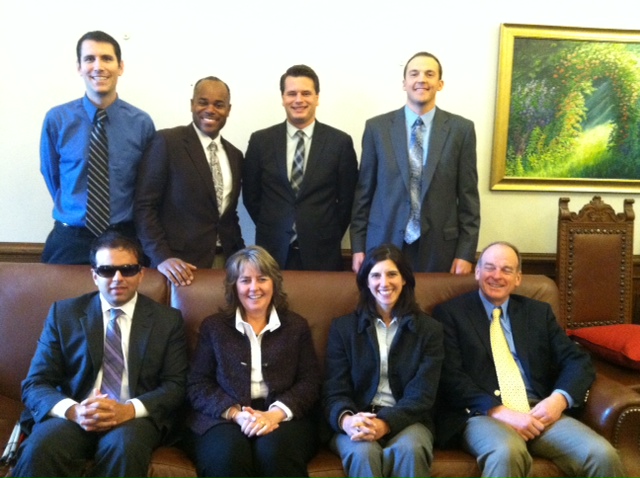
A group of Seattle University students dropped by the Capitol today, hoping to get a chance to see the House floor.  Generally, the House Chamber and the wings are not available to guests, except from the gallery.

However, Ways and Means Chair Ross Hunter happened to be on campus for a meeting and he offered the lucky group a personal, hands-on tour of the floor.

To read this story in Spanish, please click here.

New House Democrats starting early

Eight newly-elected Democratic House members arrived at the Capitol this morning to begin orientation. 

Although they don't officially start their new jobs until they are sworn in January 14, they are meeting with staff to talk about setting up their offices, hiring their legislative assistants, and other behind-the-scenes details.  Later today they will have a working lunch with Speaker Frank Chopp and Majority Leader Pat Sullivan before heading to their first caucus meeting.

Those attending are:
  • Marcus Riccelli, District 3, Spokane
  • Steve Bergquist, District 11, Renton
  • Jake Fey, District 27, Tacoma
  • David Sawyer, District 29, Tacoma
  • Roger Freeman, District 30, Federal Way
  • Gael Tarleton, District 36, Seattle
  • Jessyn Farrell, District 46, Seattle
  • Cyrus Habib, District 48, Bellevue
Dawn Morrell from Puyallup, newly-elected in the 25th District, was unable to attend. Monica Stonier is still leading in the 17th District, but those numbers are not yet final.

To read this story in Spanish, please click  here.

    Thursday, November 15, 2012

    We're baaaaaack!

    The election-year restrictions on public communications have been lifted, and your Advance will once again be posting interesting, informative, and, on occasion, entertaining tidbits about the Washington House Democratic Caucus. 

    Much has happened since the freeze went into effect and we will try to do a little catching up over the next few weeks, as well as post any breaking news from the caucus.  In fact, we will have some HDC Leadership news tomorrow afternoon.

    To read this story in Spanish, please click here.

    Saturday, June 30, 2012

    We're on vacation

    Campaign season is here once again, which means our blog needs to hibernate for a while. The HDC Advance will be taking an extended vacation in order to comply with election-year restrictions.

    You may still contact your representatives at their offices with any questions or requests for further information. For a list of representatives, click here.

    In the meantime, we encourage you to check out a variety of resources that will help you stay informed over the next several months.
    Have a great summer. We’ll be back after the election.

    To read this story in Spanish, please cick here.

    Friday, June 29, 2012

    The 'state' of all too many of our Washington students? They're falling through the cracks

    Rep. John McCoy
    'Twas the season. Speechifying season, that is -- as in, another fine season's collection of May-June "Listen up, you futures of America" graduation homilies and commencement colloquies just recently tucked into the pages of history.
    Call them academic ukases, these thousands of scholarly addresses that sent millions of young folk off to their post-secondary careers in college, trade school, or what have you. So yes, what better time than right now, what better place than right here to discuss another sort of education-related "address" defining all too well the state of all too many of their younger peers still plugging away in the K-12 scene: 1234 Falling Through the Cracks Blvd., Anytown, USA. 
    Rep. Sharon Tomiko Santos
    An unacceptably large ratio of these falling, and failing, students comprise demographic groups who show up in other unfortunate measures. These students tend to be disproportionately disciplined, for one thing, and they are more likely than other kids to be enrolled in special-education classes and underperforming schools, to receive poor grades, and to drop out of school. They’re less likely either to take advanced-placement, honors and college-preparatory classes, or to go on to college even if they do finish high school. And they constitute what's called the "achievement gap" -- that dismal crevasse between the beautiful promise of American public education and the beastly reality for too many American students.
    Which is exactly why it's such good and timely news that the House Education Opportunity Gap Oversight and Accountability Committee is working hard to make sure that "No child is left behind" isn’t just another cute bumper sticker. State law (RCW 28A.300.136) calls on this relatively recently assembled committee to "… provide ongoing advice to education agencies and report annually to the (L)egislature and the governor." State Rep. Sharon Tomiko Santos chairs the Opportunity Gap Committee, and she also chairs the House Education Committee.   State Rep. John McCoy, who is an active member of Santos' Education Committee, was also lately appointed to her Opportunity Gap Committee.
    In emphasizing his excitement at joining the new education panel, McCoy cited its statutory responsibility for "… closing the achievement gap (and affirming) the state's constitutional obligation to provide opportunities to learn for all students without distinction or preference on account of race, ethnicity, socioeconomic status, or gender." He further noted that the statute also speaks to the fact that "(a) consistent and powerful theme throughout the achievement gap studies was the need for cultural competency in instruction, curriculum, assessment, and professional development. Cultural competency forms a foundation for efforts to address the achievement gap, and more work is needed to embed it into the public school system."

    McCoy and several other legislators on the Opportunity Gap Committee are working with additional public officials and private citizens toward writing strategies for closing Washington's education chasm.

    To read this story in Spanish, please click here.

    Thursday, June 28, 2012

    What does health care reform mean to people in Washington state?

    Today’s U.S. Supreme Court ruling upholding national health-care reform (the Affordable Care Act) means that Washington state – already a national leader on health care – can continue moving forward on reforms.
    Those reforms include innovations that Washington state has led the nation in implementing,including:
    • the health care Exchange, a marketplace to make it easier to shop for health coverage;
    • the Basic Health Plan, to offer affordable health care for people who can’t afford to buy health insurance on the individual market;
    • Apple Health for Kids, part of Washington state’s effort to make sure every child has health coverage;
    • evidence-based medicine; and
    • moving away from simply paying for medical services like doctor visits and surgeries and toward paying for results – better health.
    The court ruling means national health-care reform will work hand-in-glove with Washington state’s ongoing efforts. For example, budget cuts had threatened the existence of the Basic Health Plan, but national health reform means the federal government will soon cover the state’s costs for the BHP.
    Washington was also one of the first states in the nation to set up a health care Exchange, a marketplace where people can buy private health insurance in a much simpler way than they can today.
    Right now, truly comparing health insurance would take a health care expert with a law degree, reading stacks of health care policies. The Exchange also allows individuals and businesses to buy more affordable health coverage with the advantage of federal premium tax credits.
    The Exchange board and staff are working through the steps needed to begin open enrollment on October 1, 2013, for coverage beginning January 1, 2014.
    Other steps that our state has already taken to implement the Affordable Care Act include:
    • extending health insurance to family members up to age 26, to cover college students and young adults, who typically do not have health insurance; 
    • no co-payments for preventative health care, such as immunization shots; and 
    • the elimination of lifetime caps on health benefits.
    Related links:

    Apture